
What Scenarios Open Up for Investors After the Truce in the Gulf?
The signing of the ceasefire between the United States and Iran marks a potential turning point for the balance of power in the Middle East, raising crucial questions for those focused on the United Arab Emirates. Will international capital flow back into Dubai’s real estate projects with the same intensity as in 2025? What impact will the reopening of the Strait of Hormuz have on residential and commercial property prices? And above all, have the tensions of recent weeks created new entry opportunities for the most discerning investors?
The Geopolitical Context: Temporary Truce and Limited Navigation

On April 7, 2026, the announcement of a two-week ceasefire between the United States and Iran, mediated by Pakistan, provided a first pause to a conflict that lasted forty days. The truce, preceding negotiations scheduled in Islamabad, immediately triggered a 13% drop in global oil prices. However, the situation in the Strait of Hormuz remains complex. Iran has warned that vessels transiting without permission will be targeted and has proposed collecting tolls, a move that has raised serious international concerns regarding freedom of navigation. To date, maritime traffic at this crucial junction remains reduced by 94% compared to pre-crisis levels. Although the United Arab Emirates had to intercept numerous drones and missiles during the peak of tensions, the swift implementation of the ceasefire demonstrates the diplomatic resilience of the region.
The Impact on Figures: Dubai’s Real Estate Market in Q1 2026
Contrary to what might be expected in a climate of geopolitical uncertainty, Dubai’s real estate market fundamentals have shown remarkable resilience. Data from the first quarter of 2026 highlight total sales of 176.7 billion dirhams across approximately 48,000 transactions. This represents a 23.4% year-on-year increase in value, although volumes grew more moderately (+5.5%), indicating a shift towards higher-quality assets. The off-plan segment continues to dominate, accounting for about 70% of the total transaction value, with March alone recording over 10,300 deals worth 31.2 billion dirhams. Average residential prices stand at 1,949 dirhams per square foot, with secondary villas maintaining solid valuations at 2,354 dirhams. It is undeniable that volumes contracted during the most acute phases of the conflict, but underlying interest has not waned: visits to construction sites by international investors increased by 75%, demonstrating latent demand ready to materialize.
The Investor’s Perspective: Security and Capital in Motion
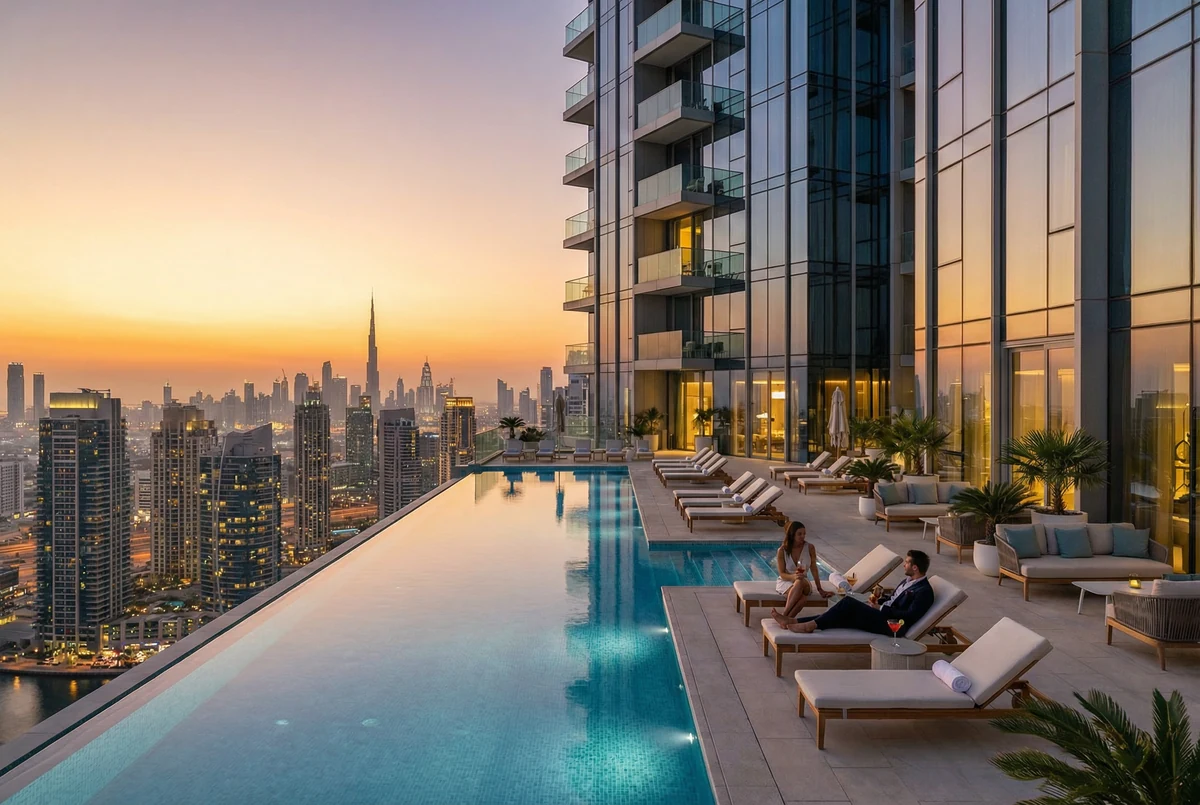
Historically, regional crises have often reinforced Dubai’s role as a safe haven for capital. The current scenario appears no different. With the restoration of a fragile stability, international demand — previously on hold pending greater clarity — is expected to flow back into the Emirati market. European, Asian, and British investors, who had temporarily paused purchasing decisions, now find a clearer framework. Furthermore, the reopening of energy flows through the Strait of Hormuz is set to stabilize revenues for Gulf sovereign wealth funds, ensuring the continuity of major infrastructure projects that underpin Dubai’s appeal. Structural dynamics remain unchanged: no property taxes, rental yields between 6% and 9%, and a steady influx of new residents estimated at 225,000 units per year.
Rema Living: The Strategic Partner to Navigate the Transition
In a market that reacts swiftly to international dynamics, relying on a locally rooted partner becomes essential. Rema Living Real Estate combines Italian entrepreneurial vision with a deep understanding of Dubai’s market logic. Our approach is based on rigorous data analysis and targeted opportunity selection, enabling investors to distinguish between temporary fluctuations and long-term structural trends. We understand the needs of those seeking not only returns but also security and procedural clarity in a context perceived as complex.
Operational Advice: Act Before Consolidation
For investors with available liquidity, the current window represents a strategic opportunity. The market is emerging from a "wait-and-see" phase and preparing to absorb the compressed demand of recent weeks. The operational advice is to focus on off-plan projects in rapidly developing areas such as Dubai South and Jumeirah Village Circle, where fundamentals remain excellent and the potential for appreciation is more pronounced. This is not the time for reckless speculation but for measured acquisitions, targeting developers with impeccable track records and assets capable of generating stable income regardless of short-term fluctuations.
