
Recent news from the Persian Gulf brings a precise question to the center of many international investors' considerations: can the uncertainty surrounding the Strait of Hormuz truly slow Dubai down, or paradoxically, does it reinforce Dubai’s profile as the region’s market safe haven? This is a legitimate question, especially at a time when geopolitical headlines are strong, but wealth decisions require a cooler, more technical analysis.
Hormuz in Tension — Is Dubai Under Pressure or Becoming Even More Central?
This is perhaps the most direct way to frame today’s topic. If one of the world’s most sensitive energy routes remains subject to operational frictions, how long can investor confidence in Dubai’s real estate persist?
The question can also be posed this way: does the partial reopening of Hormuz cause holders of international liquidity to postpone purchases, or does it increase the search for regulated, transparent, and well-connected markets such as Dubai?
Lastly, there is a third version relevant especially from a wealth perspective: during periods of geopolitical volatility in the Gulf, does Dubai lose appeal or does it consolidate its role as a stable platform for capital, business, and international residency?
What Is Truly Happening Today in the Persian Gulf
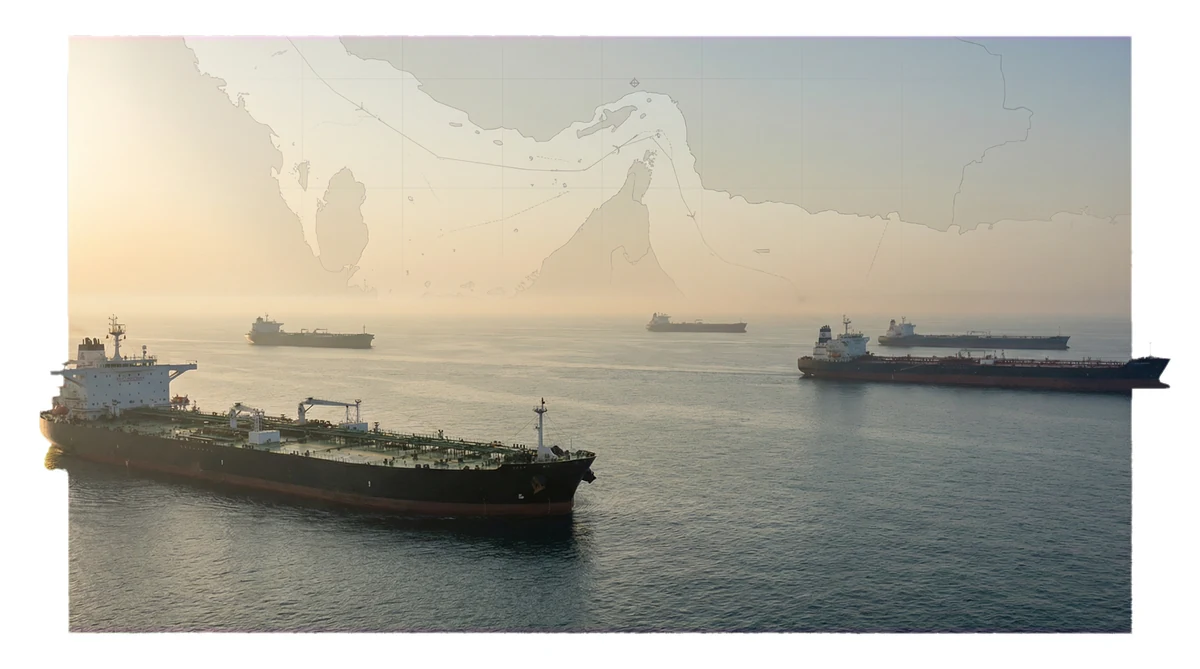
The situation today requires precision. International sources describe a fragile ceasefire between the United States and Iran, but notably, the formal reopening of the Strait of Hormuz has not yet led to an operational normalization of maritime traffic. Reuters reported that transit volumes remain far below normal levels, while a CNN reconstruction dated April 9 highlights that the Strait continues to be crucial for about 20% of the world's oil supply.
Before the conflict, according to data cited by CNN, more than 100 cargo ships transited daily through this strategic corridor. After the ceasefire, actual passages remained limited: Kpler reported just two oil and gas tankers transiting after the truce announcement, while MarineTraffic indicated over 400 tankers, 34 LPG ships, and 19 LNG vessels still waiting in the region. This means the problem is not only political but also logistical, insurance-related, and operational.
In other words, the most important news for investors is not just that a truce exists, but that the market is still pricing in caution. Shipping companies demand clarity on transit procedures, security guarantees, and stronger signals of stabilization. It is precisely this distinction between political announcements and real normalization that is making the difference in investment decisions today.
What Impact Is This Having on Dubai’s Real Estate Market?
Judging by headlines alone, one might imagine a rapidly cooling real estate market. However, the available numbers tell a more nuanced story. According to data released by the Dubai Land Department and reported by Gulf News on April 9, Dubai’s real estate sector closed Q1 2026 with transactions totaling 252 billion dirhams, a 31% year-on-year increase, and with 60,303 overall transactions, up 6%.
The update also highlights a total of 48,448 investors, up 8%, including 29,312 new investors, an increase of 14%. Foreign investments reached 148.35 billion dirhams, growing by 26%, while the luxury segment touched 87.71 billion dirhams, also rising by 26%. These figures are difficult to reconcile with a narrative of immediate market flight.
In the residential segment, Cavendish Maxwell reports 44,100 transactions in Q1, a 4.2% increase over the same period in 2025. The most notable data point is that off-plan transactions represented 73% of sales and grew by 10.3%, while the ready market declined by 9.2%. March was the softest month of the quarter, with 12,700 transactions, down 10.5% from March 2025, and with a more marked decline in the ready market. However, Cavendish Maxwell advises against prematurely attributing this slowdown solely to regional tensions, as the data include deals signed both before and after the crisis began.
The point, therefore, is not to deny that some caution exists. The point is to observe that, at least for now, this caution manifests selectively rather than as a general market halt. Off-plan sector remains stable, international investments stay high, and Dubai continues to attract capital precisely because it combines infrastructure, regulatory framework, global connectivity, and depth of demand.
What Should International Investors Consider Today?
For a serious investor, this phase should neither be viewed with euphoria nor with fear. It should be understood through scenarios. The first, more cautious scenario, foresees that regional tensions prolong decision-making times and make part of the demand more selective, especially regarding ready properties and opportunistic operations. The second scenario, equally plausible today, is that regional uncertainty continues to favor Dubai as a jurisdiction able to absorb capital seeking protection, mobility, and returns.
There are structural drivers that do not depend on the news cycle of a single week: population growth, fiscal attractiveness, visa regime, infrastructural expansion, new urban masterplans, and the emirate’s capacity to position itself as a global hub for business, families, and wealth. When these elements remain intact, geopolitical volatility does not erase investor interest; at most, it changes behavior, making it more analytical and less impulsive.

For this reason, the correct question today is not whether to invest or not absolutely. The right question is where, with what time horizon, what return objective, and what expected liquidity level. In a phase like this, location, developer quality, payment plan, rental demand, and resale potential matter even more.
Why Rema Living Can Make a Difference in Times Like These
When the external context becomes noisy, the value of an advisor is not to oversimplify but to make choices understandable. Rema Living operates precisely in this space: transforming news, data, and perceptions into practical guidance for investors who want to understand not only if Dubai remains attractive, but which operations really make sense for their specific case.
This means helping clients distinguish between emotion and strategy, between trending products and assets coherent with their profile, between commercial narrative and real numbers. On a day like today, having practical answers means knowing which areas maintain absorption, which developers perform better, which investment tickets offer more balance between return and capital protection, and which moves are better postponed.
The Most Sensible Operational Advice Today
The most useful advice is simple: do not make real estate decisions based on the day’s most alarming headline, but do not ignore the context either. Use geopolitics as a filter of caution, not as an emotional trigger. If you are considering Dubai, compare at least three real options, verify the type of demand supporting that area, analyze exit strategies and potential cash flow, and ask yourself whether your goal is asset protection, income, or appreciation.
In times when many only observe the surface of the news, those who analyze more deeply often invest better. And today, more than seeking absolute certainties, it is wise to seek method, current data, and a guide capable of reading Dubai in its real context.