

The visit starts before you enter the apartment
When I accompany an Italian investor through a Dubai community, the first thing I look at is not the marble in the lobby. I look at the pavement, the open shops, the parked cars, and who is entering and leaving the building. A good purchase is not understood only from the floor plan. It is understood by seeing how the neighbourhood lives at ten in the morning, when nobody has prepared the scene to sell it.
The data shows a large market, but not a uniform one
Dubai Land Department continues to put real-time transaction data at the centre of market transparency. In July 2026 data analysed by Reliant Surveyors, Dubai recorded around 14,263 sales worth AED 35.50 billion, with 10,013 off-plan transactions and 4,250 ready-property transactions. Apartments represented about 82.8% of sales volume, while the rental market exceeded 91,000 contracts during the month. These are important numbers, but they do not support a simple conclusion: not every building participates in this liquidity in the same way.

The real shift is that a render does not show real demand
A render can show a perfect swimming pool, but it does not tell you whether the supermarket is walkable, whether the entrance works for a tenant, whether the street is noisy at peak hours, or whether future handovers will create direct competition. Recent market readings point to a more selective phase: some segments remain very strong, while others are moving more cautiously. That is why a site visit is not a formality. It is where the numbers meet real life.
For investors, the neighbourhood matters as much as the unit
An investor buying from abroad tends to focus on price, payment plan and promised yield. These are necessary elements, but they are incomplete. In Dubai, you need to understand whether the area has real demand, whether the target tenant fits the product, whether services already exist or are only planned, whether parking works, whether access to the main road is simple, and whether the expected rent still makes sense when new supply arrives. The difference between a good purchase and a mediocre one is often here.
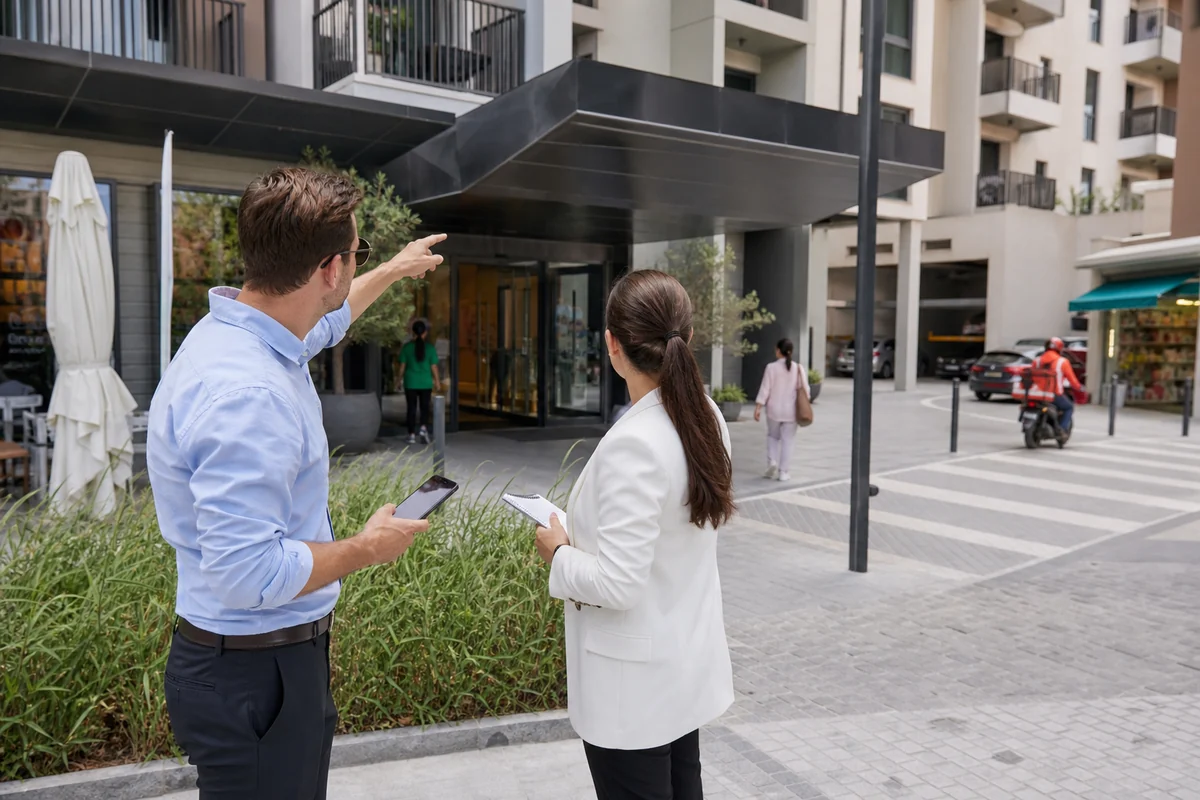
Why Rema Living checks the context before the brochure
At Rema Living, I never start from the question “which project looks best?”. I start from a more useful one: who will actually use it, and why would they pay that rent? We combine DLD data, comparables, realistic rents, developer quality, handover timelines and a physical reading of the community. If you want to assess a purchase with this method, you can book a meeting with Rema Living and build a decision on evidence, not persuasive images.
The practical check for your next viewing
Before signing, do a visit with a ten-point checklist: access, parking, noise, walkable services, maintenance of common areas, entrance quality, occupant profile, nearby construction, closed comparables and rents actually achieved. If you cannot be in Dubai, ask for an unedited video check, from outside the building to the unit. The neighbourhood does not lie. You just need to look at it with method.

