
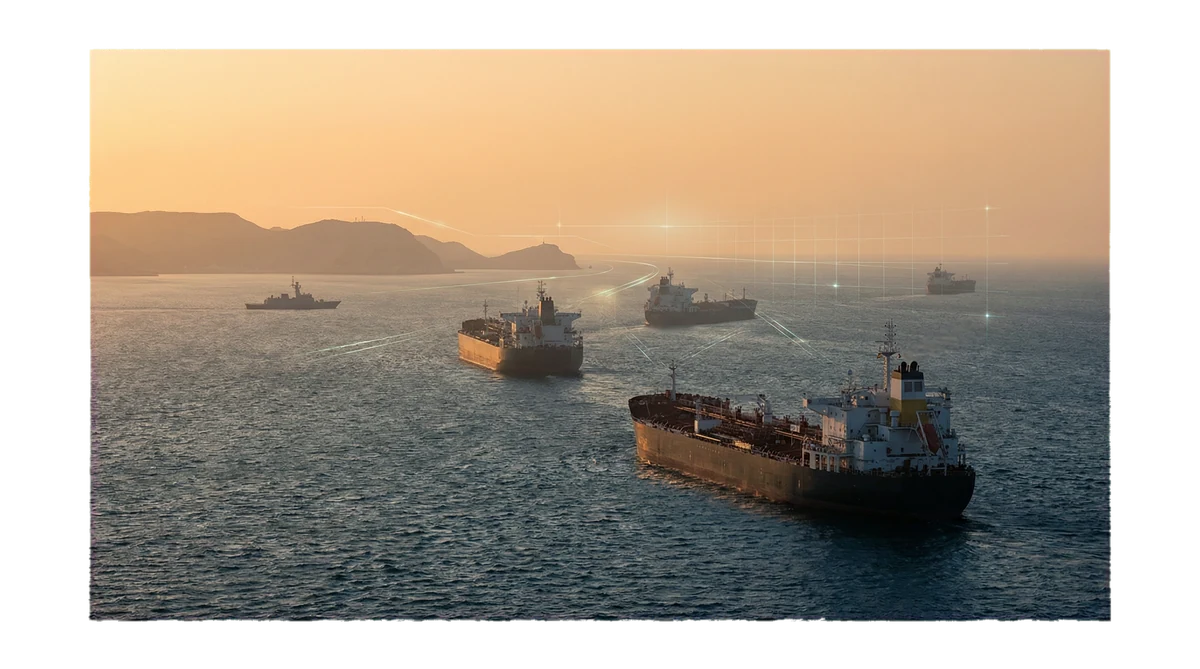
The temporary ceasefire between the United States and Iran has reduced the immediate pressure on markets, while the commitment to restore navigation through the Strait of Hormuz has eased the extreme risk perception felt by operators. For those looking at Dubai with a long-term, wealth-building perspective rather than a speculative one, the question is no longer whether volatility still exists, but whether the landscape is becoming readable enough again to support more rational decisions.
Three questions every investor is asking right now
Is the ceasefire around the Strait of Hormuz really reducing perceived risk for those investing in Dubai?
Could the cooling of geopolitical tension create an attractive entry window into UAE real estate?
After weeks of regional volatility, does Dubai property still offer stability, returns and long-term perspective?
Today's geopolitical backdrop: relief, yes, but not normality yet
The most relevant news of the past few days points in one clear direction: markets reacted with relief to the announcement of a temporary ceasefire between the United States and Iran, but they still price in a meaningful geopolitical premium. According to Gulf News, the Hormuz corridor, through which around one fifth of global oil flows transit, remains the main barometer of perceived regional risk. Reopening or preserving navigation lowers the immediate danger of logistics and energy shocks, yet market participants remain cautious because the ceasefire is temporary and its real test will be its diplomatic durability over time.
This means the situation should be read neither through an alarmist lens nor through an naively reassuring one. Tail risk has declined; macro volatility, however, has not disappeared. For an international investor, this distinction is crucial because it separates short-term emotional reactions from wealth decisions built on deeper fundamentals.
Is Dubai holding up? The numbers say the market is still moving
Available data confirms that Dubai's real estate market has not stopped. Khaleej Times reports that in the first quarter of 2026 the market recorded Dh176.7 billion across 47,996 transactions, with off-plan accounting for 70% of sales volume and 71% of total value. In March alone, despite the regional backdrop, the sector posted a 5.5% year-on-year increase in volume and a 23.4% increase in value.
The Cavendish Maxwell report, cited by both Zawya and Khaleej Times, also highlights 44,100 residential transactions in Q1 2026, up 4.2% year on year. The off-plan segment represented 73% of sales and grew by 10.3%, while the ready segment showed greater sensitivity to the climate of uncertainty, declining by 9.2% over the quarter and falling more sharply in March.
Harbor Real Estate adds another useful reading: considering Dubai's broader real estate ecosystem, Q1 2026 reached AED 251.4 billion in transactions across 61,578 deals, equal to +28.5% in value and +4.2% in volume versus the same period of 2025. In other words, the market slowed its pace in March, but it did not lose its structural strength.

What really changes for investors today
For investors, the most important message is that Dubai continues to stand out for depth of demand, absorption capacity and international appeal, but selection matters more than ever. When geopolitical risk rises, the market tends to reward well-positioned assets, projects backed by credible developers, sustainable payment plans and areas supported by infrastructure, resident population and real services.
In the short term, the backdrop may favour those who have liquidity, vision and negotiation discipline. If the ceasefire holds, part of the demand that has been waiting on the sidelines may gradually return to the market. If tensions rise again, Dubai may still continue to attract capital, but with slower decision times and a stronger focus on the intrinsic quality of each deal. In both scenarios, the right approach is not to chase news noise, but to read data, micro-locations, payment structures and the real purpose of the investment.
Why Rema Living can provide practical, not theoretical, answers
At a stage like this, value does not lie in absolute opinions, but in the ability to turn a complex scenario into concrete choices. Rema Living helps investors distinguish between media enthusiasm and real opportunity by analysing purchase goals, risk profile, time horizon, expected return and project quality. This means guiding the client with a practical, fact-based reading of Dubai's market, updated and grounded in reality.
If you are evaluating an entry into the UAE, or if you want to understand where the market is still strong and where waiting may be wiser, the right conversation today is one built on data, local experience and realistic scenarios.
The most sensible operational advice right now
The common-sense advice is simple: do not decide out of fear or euphoria. Instead, prepare a shortlist of areas, budgets, objectives and timelines, then verify which opportunities still make sense even in a scenario that is less perfect than the ideal one. If an investment remains valid even without storytelling, then it deserves attention. And this is exactly where serious local advisory makes the difference.